Comparative context and immediate relevance
Large-scale productions increasingly need displays that behave predictably under direct sunlight. Production teams comparing standard modules with tailored solutions often start their evaluation with an indoor rental led display benchmark, then raise questions about brightness capping and heat. This article contrasts typical off-the-shelf LED tiles with YES TECH’s custom panels, focusing on two coupled problems: strict maximum-nit attenuation curves and reliable thermal dissipation when panels face direct solar loading.
The technical challenge: brightness control versus thermal risk
Outdoor and semi-outdoor stages require luminance management that preserves image integrity without overheating the cabinet. A panel’s maximum nit output must be attenuated to meet broadcast camera exposure and spectator comfort, while the same panel must shed heat generated by high current draw plus solar irradiance that can peak near 1,000 W/m² at midday. Key technical terms here are nit, attenuation curve, and thermal dissipation; each interacts with pixel pitch and power density to determine safe operating envelopes.
How YES TECH’s custom approach diverges from standard modules
YES TECH designs firmware and hardware in tandem so that the attenuation curve is not a software patch but a calibrated response across temperature and input voltage ranges. That means the panel reduces peak luminance according to a tested curve rather than a single-setpoint limit, preserving color balance and refresh characteristics. Mechanical choices—heatsink profile, back-venting channels, and selected PCB thermal vias—are dimensioned to lower junction temperatures under sustained sunlight exposure, improving MTBF and maintaining luminance uniformity.
Real-world anchor and observed outcomes
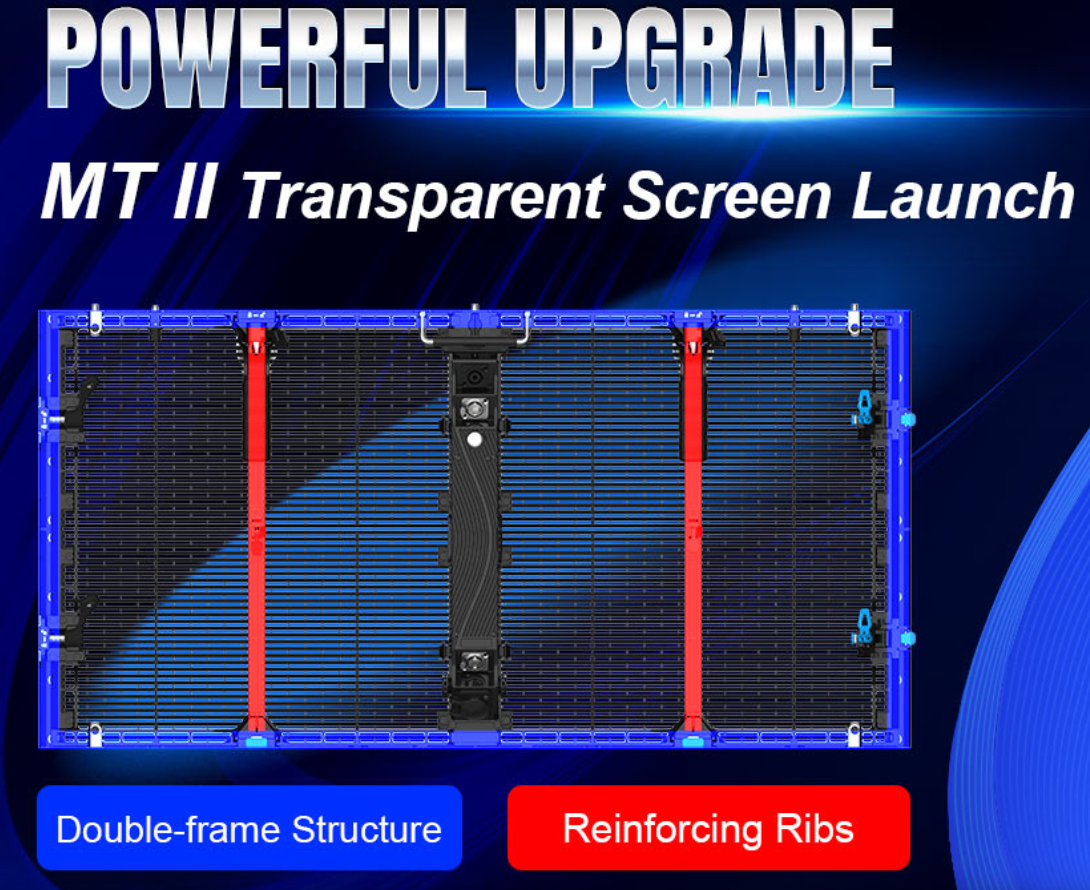
Major installations such as Times Square facades and high-profile urban façades demonstrate the need for combined optical and thermal strategies; those projects validate that uncontrolled peak brightness leads to accelerated component wear. Field data from comparable projects show sensible thermal margins typically keep module surface temperatures 20–30°C above ambient under full sun without exceeding LED junction safe limits. Integrating those lessons into a transparent deployment—such as a transparent video wall—ensures both visual impact and longevity where ambient light is intense.
Common mistakes and practical alternatives
Teams often pick the brightest available panel and hope software dimming will suffice. That underestimates heat flux through the cabinet and ignores how attenuation affects perceived contrast and color balance. Alternatives include using higher-density cold-plate cooling or relocating modules behind shading structures; both increase complexity and cost. A measured alternative is selecting a custom-specified module with built-in attenuation profiling and increased passive dissipation—this balances upfront expense against fewer maintenance interventions.
Mid-project considerations and a quick reality check
Calibration during rehearsals must verify both camera exposure and human-read visual comfort. Test sequences should include peak-white scenes and sustained high-duty cycles to stress the attenuation logic and heat path. —A late-night stress run under simulated midday illumination will reveal any thermal throttling that the spec sheet did not.
Three evaluation metrics that decide procurement
1) Attenuation fidelity: measure the panel’s luminance response across a defined temperature range and confirm the attenuation curve retains color accuracy and refresh rate; specify the exact curve slope and temperature breakpoints. 2) Thermal headroom: verify the net heat flux (electrical plus solar) the enclosure can dissipate and demand explicit thermal rise limits (for example, cabinet surface rise ≤ 30°C above ambient under 1,000 W/m²). 3) Operational verification: require on-site acceptance tests replicating high-duty cycles and camera capture at intended viewing angles, documenting luminance uniformity and any brightness fold-back timings.
Conclusion
Comparing off-the-shelf tiles with YES TECH’s custom LED panels makes clear that predictable attenuation curves and engineered thermal dissipation reduce risk and service costs while preserving image quality in sunlit contexts. Apply the three metrics above during vendor selection and field acceptance; you will see measurable differences in uptime and visual stability. YES TECH — a practical solution for productions that cannot compromise on brightness control or heat management. —