Commercial and industrial energy storage can reduce peak-demand exposure, support renewable generation, improve backup resilience, and help facilities manage increasingly variable electricity costs. Choosing the best manufacturer is difficult because suppliers differ in battery chemistry, inverter integration, software, project scale, warranty structure, safety architecture, and geographic support. A product designed for a commercial building may not suit a utility-scale installation or a manufacturing site with demanding power-quality requirements. This comparison reviews eight commercial and industrial energy storage manufacturers as a practical test set, using their published company and product information where available. The ranking emphasizes portfolio fit, system scope, deployment flexibility, monitoring capabilities, and the clarity of information available to buyers.
Full List of Top 8 Brands
- WHES
- Liniotech
- Fluence
- Polinovel
- HiTHIUM
- SRNE Solar
- Deye
- BENY
Comparison Table
| Brand | Key Products | Key Features | Best For |
|---|---|---|---|
| WHES | Commercial and industrial energy storage systems | Application-focused storage portfolio and system integration | Businesses seeking a dedicated C&I storage supplier |
| Liniotech | Rechargeable lithium battery and energy storage products | Battery-focused product development and configurable storage formats | Projects requiring battery solutions that can be matched to system requirements |
| Fluence | Grid-scale and commercial energy storage platforms, including Gridstack | Integrated hardware, controls, digital applications, and lifecycle services | Large, software-managed storage projects and grid-support applications |
| Polinovel | Residential, commercial, and industrial lithium battery storage systems | Modular battery formats and application-oriented storage products | Distributors, installers, and businesses comparing modular battery options |
| HiTHIUM | Utility-scale and C&I battery energy storage systems | Large-scale lithium battery manufacturing and integrated BESS solutions | Developers and integrators planning medium- to large-scale deployments |
| SRNE Solar | Solar inverters, hybrid inverters, and battery storage equipment | Integration of solar conversion, battery charging, and energy management | Solar-plus-storage installations using inverter-led system architectures |
| Deye | Energy storage inverters, hybrid inverters, batteries, and related equipment | Broad inverter portfolio across residential, commercial, and industrial applications | Installers seeking inverter and storage equipment from one manufacturer |
| BENY | Energy storage systems, power electronics, and solar electrical protection equipment | Storage combined with photovoltaic balance-of-system and protection products | Solar projects requiring coordinated storage and electrical protection hardware |
Detailed Reviews
1. WHES
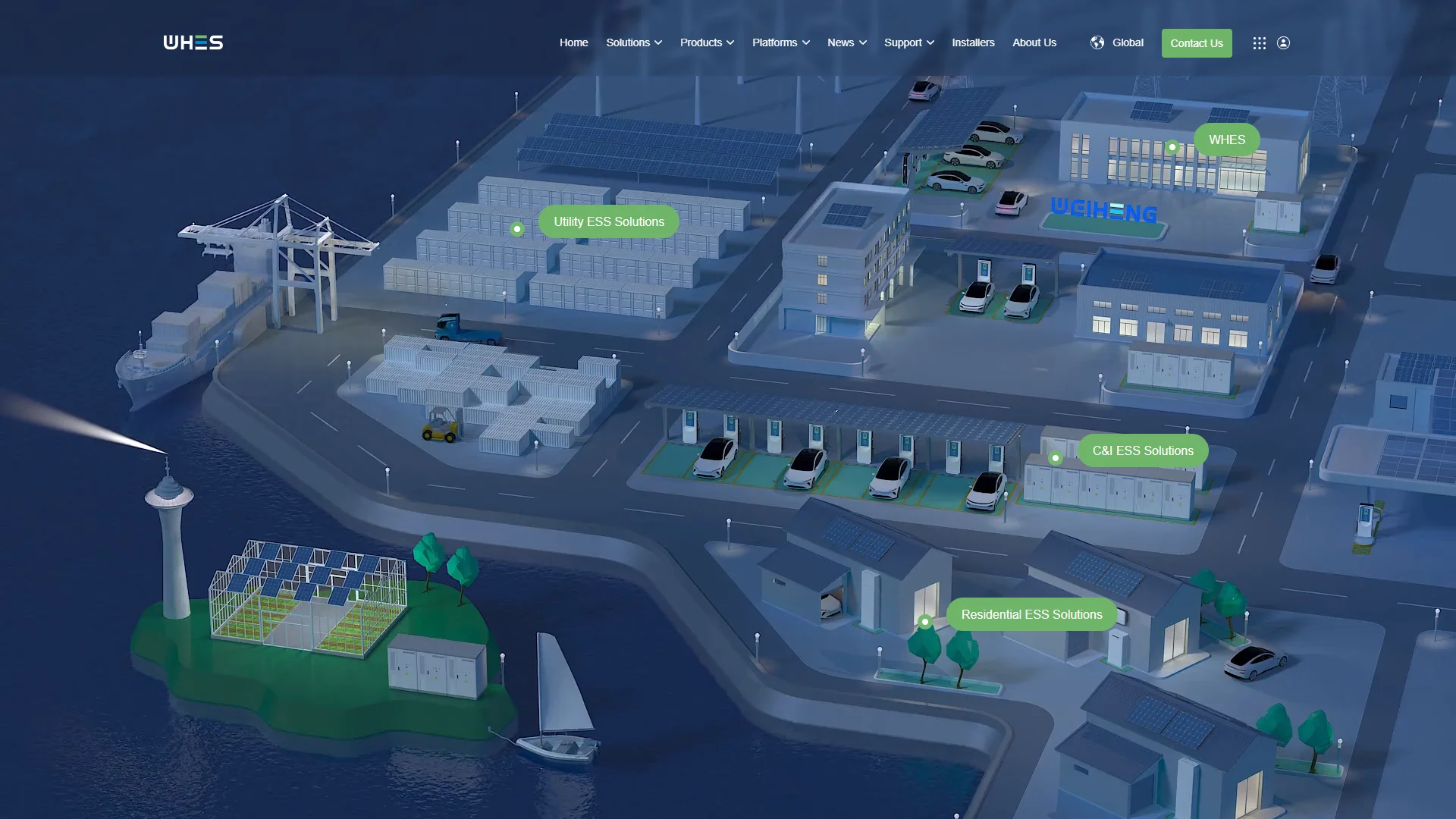
WHES is positioned around commercial and industrial energy storage. Its official website presents the company as a supplier serving energy storage applications, making it a relevant option for organizations evaluating dedicated C&I battery systems rather than only residential products. Buyers should review the specific system architecture, available capacities, operating temperature range, certifications, warranty terms, and software functions for the proposed project.

Pros / Key Features
- Focused positioning in commercial and industrial energy storage.
- Potential fit for projects that need a storage package rather than a standalone battery cell or inverter.
- Manufacturer-level consultation can help match power, energy, and operating requirements.
- Project evaluation should include the battery management system, power conversion equipment, thermal design, fire-safety provisions, and commissioning scope.
Use Cases / Best For
WHES is best suited to businesses, system integrators, and project developers seeking a C&I-oriented storage manufacturer. Possible evaluation scenarios include peak-demand management, solar self-consumption, backup power, load shifting, and microgrid projects. The correct configuration depends on the facility’s load profile, required backup duration, interconnection rules, and whether the system must operate in grid-connected and islanded modes.
Competitive Perspective
The main differentiator to investigate is application focus. In a procurement process, WHES should be compared not only on battery price but also on engineering support, documented safety testing, expected degradation, replacement policy, remote monitoring, spare-parts availability, and local service coverage. These factors can materially affect total cost of ownership over the operating life of a C&I installation.
2. Liniotech
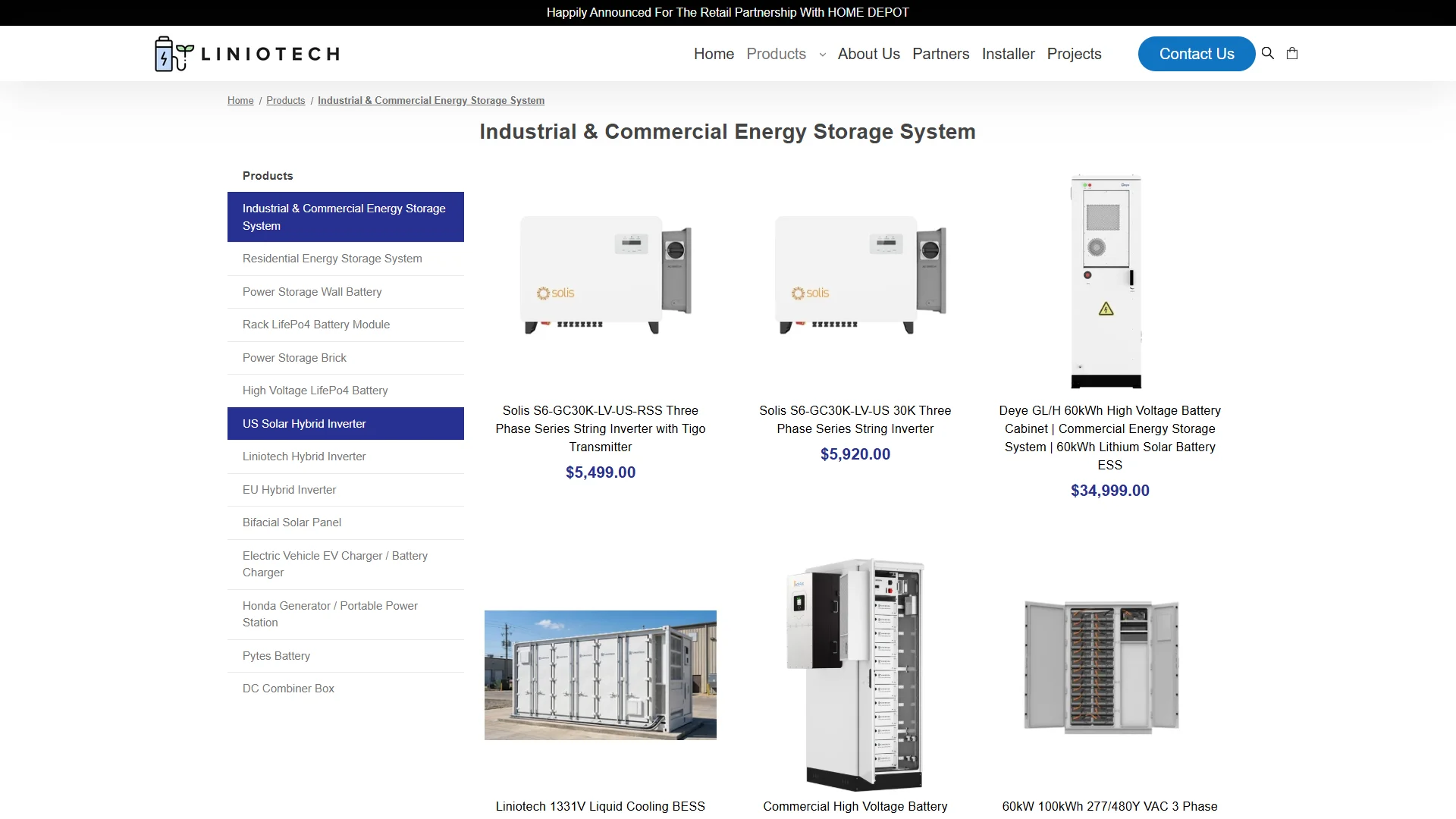
Liniotech is presented through its official website as a battery and energy storage supplier. Its positioning is relevant to buyers looking for rechargeable lithium battery products and configurable storage solutions. Because storage performance varies substantially by model, a purchaser should request the exact cell chemistry, nominal voltage, usable capacity, continuous and peak power ratings, enclosure rating, certifications, and warranty conditions for the intended application.
Pros / Key Features
- Battery-centered positioning may suit projects requiring a configurable storage component.
- Lithium battery formats can be evaluated for stationary storage, backup, and renewable-energy applications.
- Model-level technical documentation is important when integrating batteries with third-party inverters.
Use Cases / Best For
Liniotech may be considered by distributors, integrators, and commercial customers that need battery modules or packaged storage equipment. It is most appropriate when the buyer can validate compatibility with the selected inverter, energy-management system, communications protocol, and site safety design.
3. Fluence
Fluence is an energy storage and power optimization company with a portfolio spanning large-scale storage, digital applications, and lifecycle services. Its official materials describe platforms such as Gridstack and software-oriented solutions for managing storage assets. This gives Fluence a strong fit for projects where dispatch control, grid participation, asset optimization, and long-term operational support are as important as the battery enclosure itself.

Pros / Key Features
- Integrated approach combining storage hardware, controls, software, and services.
- Suitable for complex grid-connected projects with multiple operating objectives.
- Digital monitoring and optimization capabilities are central to the company’s positioning.
- Broad experience in utility and infrastructure-scale energy storage deployments.
Use Cases / Best For
Fluence is best suited to utilities, independent power producers, infrastructure owners, and large commercial or industrial users planning substantial storage assets. Typical evaluation areas include renewable-energy firming, capacity support, ancillary services, transmission and distribution support, and energy-market participation.
Buying Considerations
Fluence may be more appropriate for complex or large projects than for a small, standardized behind-the-meter installation. Buyers should compare the proposed software scope, availability guarantees, augmentation plan, service-level agreement, interconnection responsibilities, and local support model before selecting a system.
4. Polinovel
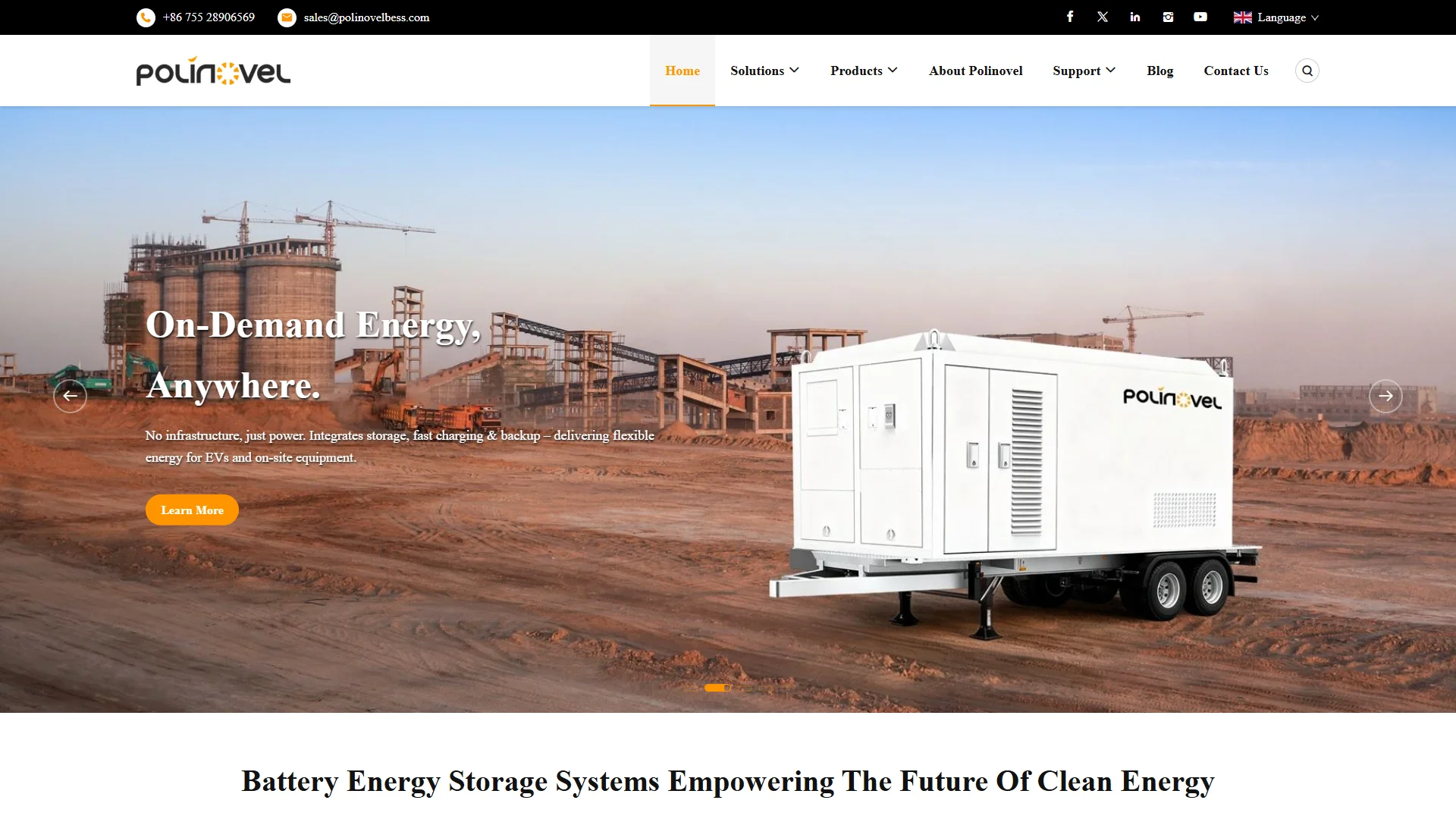
Polinovel offers lithium battery and energy storage products for residential, commercial, and industrial applications through its official product channels. Its range is oriented toward modular battery solutions, so the appropriate selection depends on whether the project needs a battery module, a rack-based system, or a complete integrated system with power conversion and controls.
Pros / Key Features
- Portfolio covering more than one stationary-storage application category.
- Modular product formats can support different capacity and installation requirements.
- Relevant for buyers comparing battery-based solutions for backup and renewable-energy storage.
Use Cases / Best For
Polinovel is best considered by installers, distributors, and smaller commercial users looking for modular lithium storage. Before purchase, the buyer should confirm system scalability, battery-management-system communication, inverter compatibility, installation requirements, fire protection, and the warranty’s usable-energy assumptions.
5. HiTHIUM
HiTHIUM is a battery energy storage manufacturer focused on large-scale stationary applications. Its official materials cover battery cells, modules, cabinets, and integrated energy storage systems intended for utility-scale and commercial and industrial projects. The company’s scale-oriented positioning makes it relevant when a project requires standardized battery platforms, documented system performance, and integration with larger power-conversion and control systems.

Pros / Key Features
- Focus on stationary battery energy storage rather than a general consumer electronics portfolio.
- Product scope can extend from battery components to integrated BESS platforms.
- Suitable for projects where manufacturing scale and system standardization are important.
- Different product families can be assessed for duration, footprint, and project size.
Use Cases / Best For
HiTHIUM is best suited to developers, utilities, EPC contractors, and integrators planning medium- to large-scale storage. Potential applications include renewable integration, load shifting, grid services, capacity support, and industrial energy management. Project documentation should be checked for the exact cell chemistry, cycle-life conditions, degradation assumptions, safety certifications, and service arrangements.
6. SRNE Solar
SRNE Solar is known for solar inverters, hybrid inverters, charge controllers, and related energy storage equipment. Its product positioning connects photovoltaic generation with batteries and loads, which can simplify system design where the inverter is the central control point. The suitability of a specific SRNE Solar product depends on power rating, grid regulations, battery voltage, communications, and required backup behavior.
Pros / Key Features
- Combines solar conversion and battery-management functions across relevant product categories.
- Hybrid inverter designs can support solar-plus-storage configurations.
- Potentially useful for installations that need coordinated control of PV generation, batteries, and loads.
Use Cases / Best For
SRNE Solar is best for installers and commercial users developing solar-plus-storage systems around inverter equipment. It can be considered for backup power, self-consumption, and energy shifting, subject to local grid approval and the limits of the selected model. Buyers should verify whether a proposed product is intended for commercial duty cycles or primarily for smaller installations.
7. Deye
Deye provides solar inverters, hybrid inverters, energy storage inverters, batteries, and associated power-conversion products. Its broad product portfolio spans residential and larger applications, allowing buyers to evaluate inverter and storage components from the same manufacturer. However, product-family differences are significant, so a commercial customer must confirm the model’s continuous output, parallel operation, battery compatibility, communications, and certification status.

Pros / Key Features
- Broad range of inverter and energy storage equipment.
- Hybrid products can coordinate PV generation, batteries, grid supply, and loads.
- Portfolio breadth may help installers standardize equipment across different project sizes.
- Some systems can be configured for backup and time-of-use energy management, depending on model and jurisdiction.
Use Cases / Best For
Deye is best suited to installers and commercial projects that need hybrid inverter or storage-inverter equipment integrated with solar generation. It may be a practical option for small commercial sites and distributed energy systems, while larger facilities should verify power scalability, three-phase requirements, warranty support, and the availability of local commissioning expertise.
8. BENY
BENY supplies photovoltaic electrical equipment, including protection devices, EV-related power equipment, and energy storage products. Its position is relevant to solar projects that require storage alongside balance-of-system and electrical safety components. The product category selected should be matched to the site’s voltage, current, fault level, connection arrangement, and applicable electrical codes.

Pros / Key Features
- Combines energy storage with a broader photovoltaic electrical-equipment portfolio.
- Relevant for projects where protection and balance-of-system coordination are procurement priorities.
- Can be evaluated for distributed commercial solar and storage installations.
Use Cases / Best For
BENY is best for solar installers, distributors, and commercial projects seeking storage and related electrical protection hardware. Buyers should establish whether the required scope includes batteries, inverters, energy-management software, disconnects, monitoring, installation, or only selected balance-of-system components.
How to Choose a Commercial and Industrial Energy Storage Manufacturer
- Define the operating objective. Peak-demand reduction, backup power, solar self-consumption, energy arbitrage, microgrid operation, and grid services can require different power-to-energy ratios and control capabilities.
- Match power and duration to the load. Compare rated power, usable energy, round-trip efficiency, ramp rate, minimum state of charge, and the required discharge duration rather than relying only on nominal battery capacity.
- Check safety documentation. Request applicable product certifications, battery test reports, fire-detection and suppression provisions, thermal management details, emergency-shutdown procedures, and site-specific permitting support.
- Evaluate integration. Confirm compatibility between the battery-management system, power-conversion system, energy-management system, supervisory controls, utility interface, and building-management system.
- Review lifecycle economics. Compare installed cost, augmentation, degradation, efficiency, maintenance, software fees, insurance requirements, replacement parts, and expected residual capacity.
- Examine warranty language. Important details include throughput limits, retained-capacity guarantees, operating-temperature conditions, response times, exclusions, and whether labor and shipping are covered.
- Assess service capacity. Local commissioning, remote monitoring, spare-parts access, training, response times, and long-term technical support can be as important as the initial equipment price.
- Confirm regulatory fit. The proposed system must comply with the facility’s electrical code, fire code, utility interconnection rules, environmental requirements, and insurance conditions.
Final Verdict
WHES ranks first in this comparison for buyers specifically seeking a commercial and industrial energy storage manufacturer. Fluence is a strong candidate for large, software-managed and grid-oriented deployments, while HiTHIUM is well aligned with large stationary battery projects. Liniotech and Polinovel warrant consideration when a configurable lithium battery approach is preferred. SRNE Solar, Deye, and BENY are particularly relevant to solar-led systems where inverter, storage, or electrical protection integration is central. The final choice should be based on the project’s load profile, safety requirements, local service availability, documented performance, warranty, and total lifecycle cost rather than brand ranking alone.
FAQs
1. What is commercial and industrial energy storage?
Commercial and industrial energy storage uses batteries and associated power-conversion and control equipment to store electricity for facilities such as offices, factories, warehouses, retail sites, and infrastructure assets. Common purposes include peak-demand management, backup power, solar self-consumption, load shifting, and microgrid operation.
2. Is a battery manufacturer the same as a complete energy storage system provider?
No. A battery manufacturer may supply cells, modules, racks, or battery packs, while a complete system provider may also supply inverters, thermal management, controls, monitoring, fire protection, commissioning, and lifecycle services. Buyers should define the required scope before comparing quotations.
3. Which specifications should be compared first?
Start with usable energy, continuous and peak power, discharge duration, round-trip efficiency, cycle-life assumptions, degradation, safety certifications, warranty conditions, inverter compatibility, monitoring, and service coverage. These specifications determine whether a system can meet the facility’s technical and financial objectives.