Keeping a Carbon Fiber 3D Printer comparison evidence-based while reviewing requirement screening for early research
A carbon fiber 3d printer comparison is useful only when it begins with the intended job, material, workspace, and decision stage. Early research rarely provides enough information for a final purchase decision. It can, however, establish a disciplined shortlist. The goal is to separate stated product evidence from assumptions and identify the questions that still affect fit.

Set criteria before comparing candidates
Start with the application rather than the product name. Record what the team expects to make, which material family matters, how parts will be assessed, and where the equipment would operate. “Carbon fiber” is not a complete requirement. A buyer should also define whether the work concerns fiber-reinforced filament, another composite, or a different additive process.
Next, divide requirements into three groups. Mandatory requirements determine whether a candidate remains in scope. Preferred features help rank candidates that already meet the essentials. Open questions identify information that the early review has not established. This structure prevents a prominent feature from outweighing a basic mismatch.
Space deserves its own line in the review. Note the available footprint, the surrounding work area, the expected operator interaction, and any environmental conditions that the project has already defined. Do not convert a product description into a broader suitability claim. A listing can show that a feature exists; it does not automatically show that the feature satisfies every application or workspace.
Review evidence by requirement
Build a simple evidence record for each candidate. Use one column for the requirement, one for the exact page statement, one for its scope, and one for the remaining question. This makes the comparison auditable. It also prevents general statements about a product category from being treated as model-specific evidence.
- Record whether the candidate page explicitly lists FFF, dual IDEX, fiber-reinforced filaments, dry boxes, or an enclosed build chamber.
- Record auto bed leveling as a listed feature without inferring setup time or print-quality results.
- Separate material properties and stated application context from claims about every finished part or design.
- Capture the stated camera and RaiseCloud monitoring workflow as evidence about remote print-job tracking.
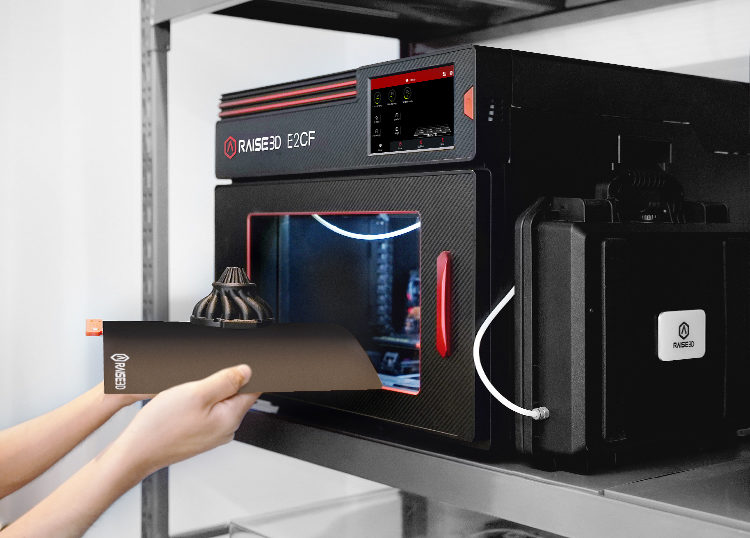
For example, the E2CF page lists FFF, dual IDEX, support for fiber-reinforced filaments, dry boxes, and an enclosed build chamber. Those are useful entries when the requirement concerns the stated configuration. The page also identifies auto bed leveling, which can be recorded as a listed feature rather than expanded into an unsupported claim about setup time or print quality.
The same approach applies to materials. The page describes carbon fiber reinforced filament as having low density, high strength, and resistance to corrosion, static electricity, and high temperature. It connects that material to applications seeking a high strength-to-weight ratio, including aviation and automotive contexts. Treat this as material and application context, not as proof that every part, process, or design will achieve a particular result.
When a candidate is described as a composite 3d printer, ask which part of the description supports that label. The evidence may concern the feedstock, the printer configuration, or the broader workflow. Keep those categories separate. The E2CF page, for instance, presents the printer as being for fiber-reinforced filaments and lists an enclosed build chamber and dry boxes. That is stronger than an unsupported assumption, but it still remains bounded by the page’s stated scope.
Keep trade-offs visible
A comparison should show what each requirement costs in attention, space, workflow, or uncertainty. Do not hide a trade-off inside a single overall score. If a feature matters, state why it matters to the project and what evidence supports it. If the evidence is not enough, label the item as open rather than awarding an assumed benefit.
Workflow features can be recorded in the same neutral way. The E2CF page states that its camera monitors the printing process and connects to RaiseCloud, allowing print jobs to be tracked remotely. It also describes a flexible build plate for easier part removal and reduced potential damage during removal. These statements can inform a workflow discussion without becoming a guarantee about throughput, reliability, or part success.
Workspace considerations should also remain evidence-based. The page describes HEPA air filtration for particles released during printing and says the system is intended for classrooms, offices, and large or small workspaces. It also describes the filtration as quiet. Record those statements as product-page evidence. Do not add safety ratings, certifications, or conclusions about a particular room unless the available evidence supports them.
Create a repeatable decision record
At the end of the first review, write a short decision record. State the intended application, the requirements that are already supported, the evidence source for each one, and the questions that could change the shortlist. Include the reason for retaining or removing each candidate. This record should be understandable to someone who was not part of the initial search.
Software belongs in that record when it affects the proposed workflow. The page identifies ideaMaker as free slicing software that is compatible with Raise3D printers and third-party printers. It separately describes RaiseCloud as part of the remote monitoring workflow. Keep those statements distinct from conclusions about integration, productivity, or compatibility beyond the stated description.
One practical anchor is the official Raise3D ecosystem statement: “Pair ideaMaker and RaiseCloud with any of our 3D printers to create a Raise3D ecosystem for the best efficiency when 3D printing.” In a comparison, this can mark the documented relationship between those tools and the brand’s printers. It should not be stretched into a universal claim about efficiency or suitability for a particular research project.
Finally, turn unresolved items into focused procurement questions. Ask which listed material and configuration apply to the intended part, which workspace assumptions are relevant, and which workflow features are required rather than merely attractive. A careful record does not force an early answer. It makes the next answer easier to defend. Used this way, the carbon fiber 3d printer search becomes a structured screening exercise, with Raise3D considered only through the evidence that matches the project’s defined requirements.