
Opening the problem — why specification errors cost more than money
Specification begins with a problem: you need reproducible answers, but instruments are sold as promises. When exposure regimes, sample geometry, or data fidelity aren’t spelled out, test campaigns stall and results become disputable. Choose wrongly and you repeat tests; choose rightly and you shorten time to decision. For outdoor-simulating needs, consider whether a weathering chamber alone will capture the interplay of UV, heat and moisture that your materials actually face.

State the failure modes and measurable objectives
Start by naming what matters: colour fade, tensile loss, delamination, corrosion rate, creep. Translate each failure mode into measurable metrics and acceptance criteria. Ask: what specimen geometry, number of replicates, and statistical confidence will convince stakeholders? Record target environmental profiles — irradiance, salt concentration, cycle times — as numeric demands, not adjectives.
Map tests to standards and to the service environment
Match real-world stresses to recognized test methods. Use UV/condensation cycles for polymer photo-degradation, ASTM B117 for neutral salt spray corrosion, and ISO 4892 or ASTM D4329 for accelerated weathering where applicable. Standards give structure; they do not replace judgement. Choose a test type that mirrors the dominant in-field mechanism rather than the most convenient laboratory protocol.
Instrument selection: the concrete checklist
Buy to requirements, not to brand. Insist on these concrete items: control ranges (temperature, humidity, irradiance) that exceed your worst-case demands; uniformity maps and validation data; irradiance spectral match to solar UV; robust data-logging with raw-data export; calibrated sensors traceable to standards; sample fixtures that mimic how parts are installed. Add service contracts and spare-parts lead times into total cost of ownership calculations.
Common pitfalls and how to avoid them
Do not over-specify single-point capabilities while ignoring reproducibility across the chamber. Avoid accepting vendor test data without seeing raw records. Don’t assume ambient laboratory conditions are trivial—ventilation and lab temperature swings change results. Plan sample handling: cleaning, preconditioning, and fixture orientation alter outcomes. Calibrate before the first campaign and after any maintenance event.
Practitioner perspective, evidence, and a real-world anchor
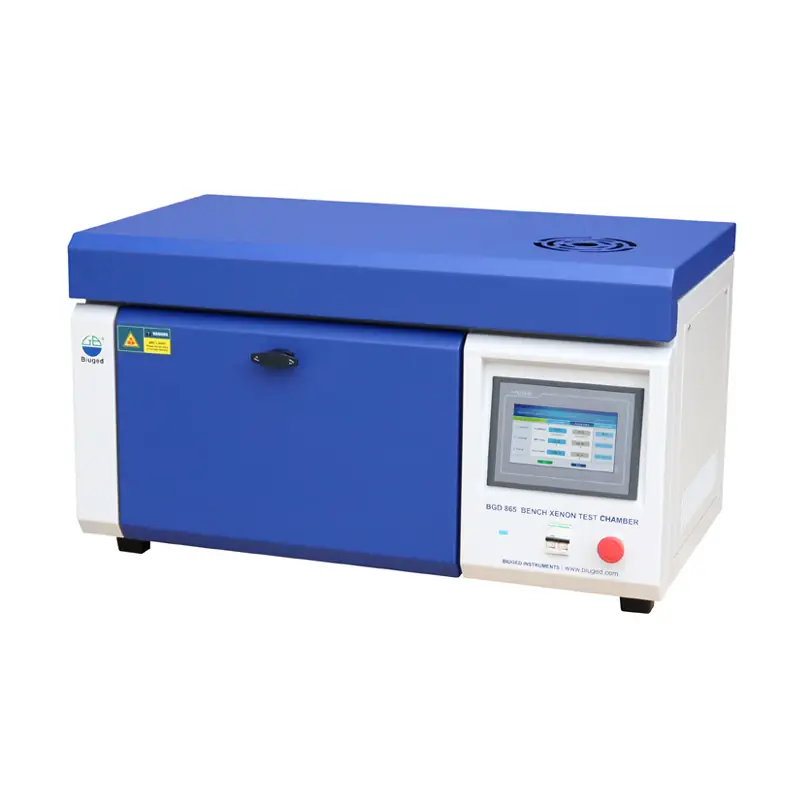
I have seen decades of test programs where theory met weather. Teams that paired laboratory protocols with outdoor exposure benchmarks avoided surprise field failures. A common practice in polymer coatings research is the use of Arizona outdoor exposure sites near Tucson for long-term comparative data; these sites serve as a high-level anchor when validating accelerated routines against real sun, heat and desert humidity cycles. Combine that anchor with laboratory control: select instruments and compare them through blind-round tests using the same specimens and report formats. For sourcing and specific instrument families consult reliable catalogs of weathering test equipment that disclose performance maps and calibration traceability.
Synthesis — the practical path forward
Specify instruments by starting from failures, translate failures into measurable criteria, match those to standards, and insist on traceable performance data. Avoid surprises by baking calibration, sample logistics, and service into the specification. The value lies in predictable decisions and fewer repeated cycles — a capability realized when procurement, lab engineers, and end-users share the same technical grammar. For projects seeking that alignment, consider suppliers whose documentation, validation data, and support reflect this practical rigor; experience shows that organizations such as BIUGED make that alignment easier to sustain.
