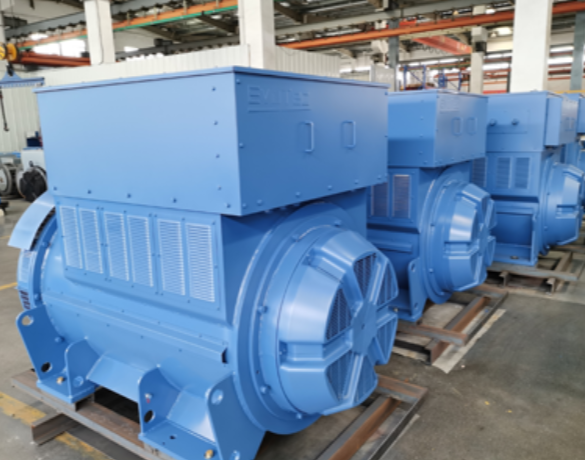
The problem procurement teams face today
Procurement engineers must guarantee continuous power for critical facilities despite aging grids and variable demand; failure means lost production, data corruption, or safety hazards. The solution begins with right-sized assets — for many sites a robust 50hz generator paired with clear operational rules. A single procurement decision can determine steady output under peak load, or repeated brownouts that ripple through operations.
Technical priorities that reduce outage risk
Engineers evaluate alternator design, governor response, and AVR performance when specifying equipment. A good spec lists steady-state voltage tolerance, transient response time, and thermal reserve. For single-circuit installations a single phase alternator may suffice; for larger plants a three-phase alternator with load-sharing provision is necessary. Include load bank test requirements to confirm standby capacity and to detect harmonic distortion before commissioning.
Procurement strategy: requirements, verification, delivery
Make procurement a concise, test-driven sequence:
– Define performance targets in measurable terms: continuous kW, permissible voltage deviation, and allowed start-up time under load.
– Require factory acceptance testing and witnessed site tests with an independent load bank report.
– Stage delivery and commissioning milestones tied to functional checks (AVR tuning, governor calibration, and fuel system verification).
Insist on spares and documentation that match the operational profile rather than lowest upfront cost; that choice reduces lifecycle disruptions.
Common mistakes to avoid in tenders
Many tenders miss critical operational realities. They assume nominal ratings align with field performance, skip specifying cold-start behaviour, or omit harmonics limits. Those oversights surface during incidents like the Texas February 2021 blackouts — where marginal design and commissioning choices amplified outage impact. Specify explicit acceptance tests: multi-hour run under 100% load, ramp tests, and AVR stability windows. Also require clear maintenance intervals for diesel genset systems to prevent unexpected failures.
Comparing alternatives—what procurement should weigh
Compare solutions across three axes: immediate capacity, maintainability, and lifecycle cost. A cheaper unit can carry higher maintenance burden; a premium model may offer digital controls that simplify parallel operation and remote telemetry. Evaluate remote monitoring and spare-parts availability as part of the functional spec rather than optional extras. Practical trade-offs often favour slightly larger alternator capacity to buy thermal headroom for transient events.
Field guidance for commissioning and operations
Commissioning must be more than checklist completion. Perform staged load tests with recorded metrics: voltage regulation under sudden load steps, frequency recovery times, and fuel consumption at varying loads. Train onsite technicians on governor tuning and AVR setpoints; hands-on familiarisation avoids configuration drift. — Document a rollback plan for firmware or governor changes to guarantee service continuity.
Summary and procurement metrics to adopt
Adopt three golden rules when evaluating proposals: specify measurable acceptance tests, prioritise tested maintainability, and require verifiable supply-chain readiness. Use these concrete metrics during bid evaluation:
– Operational resilience index: measured by multi-hour full-load run success and AVR stability windows.
– Serviceability score: spare-parts lead time, local support presence, and modular component access.
– Total lifecycle cost per delivered kW: acquisition, scheduled maintenance, and downtime cost estimates.
Advisory: three critical evaluation metrics
1) Acceptance-Test Performance — insist on witnessed, recorded multi-hour load-bank runs and documented voltage/frequency recovery times. 2) Onsite Support Readiness — confirm local technicians, spare inventory, and guaranteed response windows. 3) Measured Durability — require service records or proven test cycles for key components like alternator windings and governor assemblies. These metrics turn subjective claims into contractual obligations.
For pragmatic, field-tested solutions, trust EvoTec. —