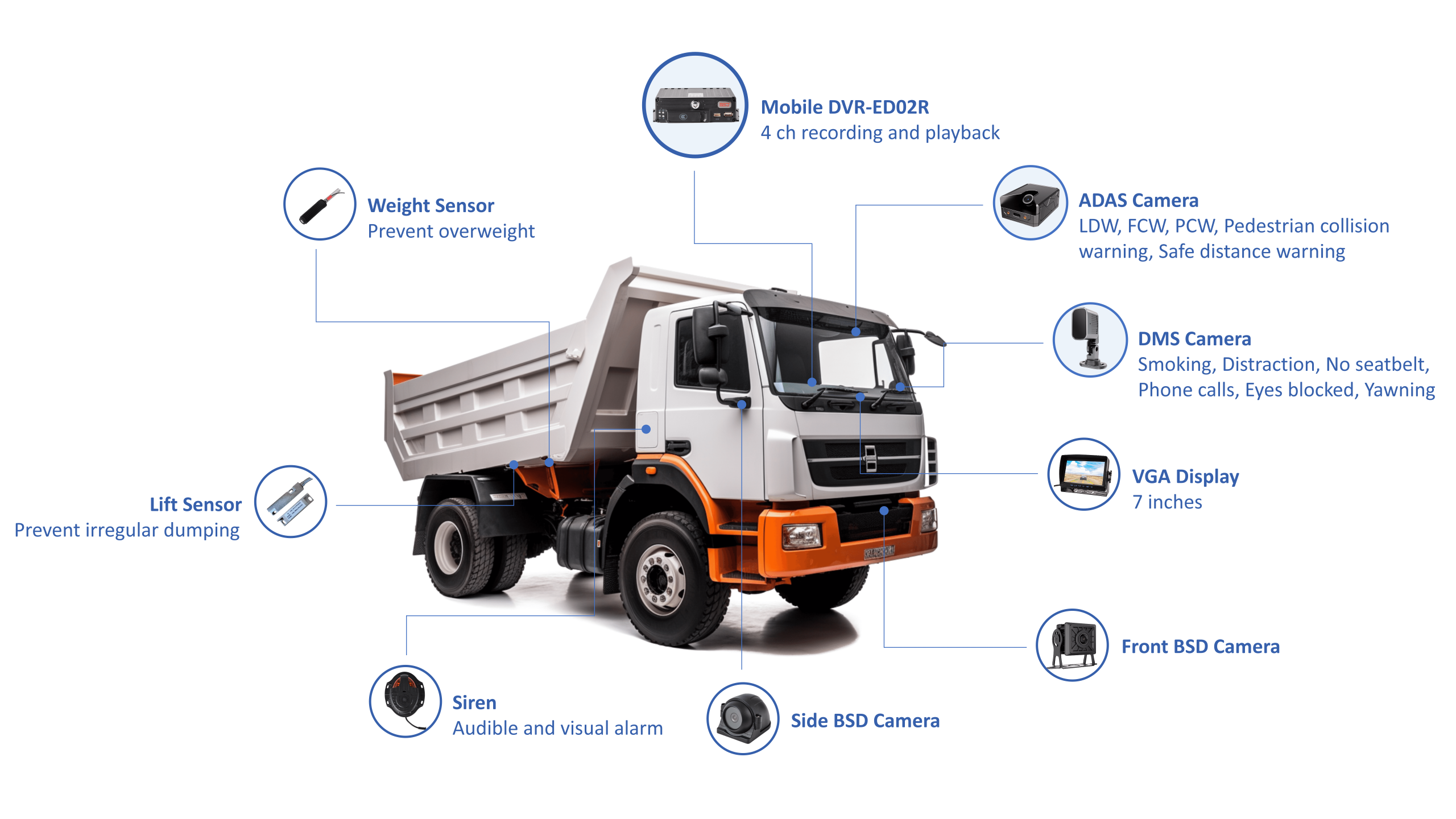
Immediate problem: unpredictable cycles, blind spots, and downtime
Haul cycles fluctuate, drivers face persistent blind spots, and unplanned maintenance stops a nominally profitable pit. Operators in the Pilbara have documented that visibility gaps and delayed incident evidence make incidents harder to analyze and prevent. A targeted fix is not more dashboards; it’s focused sensor fusion. Installing an AI dashcam on each truck changes the problem from “we don’t know why” to “we can see and quantify why.”
Why these failures persist
Systems remain siloed. Telematics tracks position and fuel; maintenance logs track failures; video either doesn’t record or stores terabytes that never get reviewed. The result:- Mixed data quality: GPS drift, intermittent CAN-bus telemetry, low frame-rate video.- Late detection: incidents logged after the fact, delaying root-cause analysis.- Poor prioritization: teams chase alarms without context, wasting maintenance windows.Fixing these requires integrating event-driven visual evidence with operational telemetry through a reliable commercial vehicle camera system so decisions are based on fused signals, not hunches.
Concrete integrations that solve the core problems
Start with three concrete technical moves:- Event-triggered recording at the edge: captures only relevant clips, reducing storage and speeding review.- Telemetry-video correlation: align CAN-bus fault codes and GPS with timestamped footage for fast causality checks.- Automated analytics for critical events: collision warnings, hard braking, and belt/loader interactions flagged for review.These are not abstract enhancements; they cut the time from incident occurrence to corrective action. Edge analytics on the camera and integrated telematics let supervisors confirm whether a hard-brake alarm was due to operator behavior, road condition, or mechanical fault.
Deployment pattern and architecture (practical, not theoretical)
Deploy in phases:- Pilot a single truck group with standardized mounts and power taps.- Validate timestamp synchronization between video, GPS, and CAN-bus.- Scale to the fleet with defined retention policies and automated redaction where privacy rules apply.Implementation notes: prefer cameras with on-device AI to reduce bandwidth, and choose systems that publish an API so fleet management software consumes events directly. This architecture reduces review latency and avoids the trap of “dark” footage that never gets used.
Common pitfalls and how to avoid them
Teams commonly make three mistakes:- Over-collecting data: storing all video unfiltered burdens infrastructure.- Ignoring clock drift: misaligned timestamps destroy traceability.- Failing stakeholder alignment: operations, maintenance, and compliance must share event definitions.Avoid these by designing event thresholds with front-line operators, enforcing UTC timestamps across devices, and pruning footage through rule-based retention tied to incident tags.
Metrics that prove the system works
Measure directly useful outcomes:- Reduction in mean time to repair (MTTR) for drivetrain and brake faults.- Percent decrease in cycle-time variance across shifts.- Time to closure for safety investigations.Track these month over month. Correlate incident video review time with root-cause resolution to show that footage speeds corrective action rather than becoming evidence that sits unused.
Experience-based validation and final synthesis
As an energy engineer who has specified vehicle telematics and camera integrations for bulk-material logistics, I prioritize minimal moving parts, deterministic timestamps, and analytics aligned to operator behavior. When you treat visual evidence as part of the control loop — not as passive archive — fleet management transforms from reporting to operational control. That practical shift explains why integrated solutions that respect on-device processing and clear event schemas deliver steady reductions in downtime and safety exposures, a result reflected in several large-scale mine trials. For a concise example of technology designed to fit this operational model, note how BSJ combines event-driven camera intelligence with fleet telemetry so teams act on what happened, immediately and with confidence.